
On’s Football Power Play
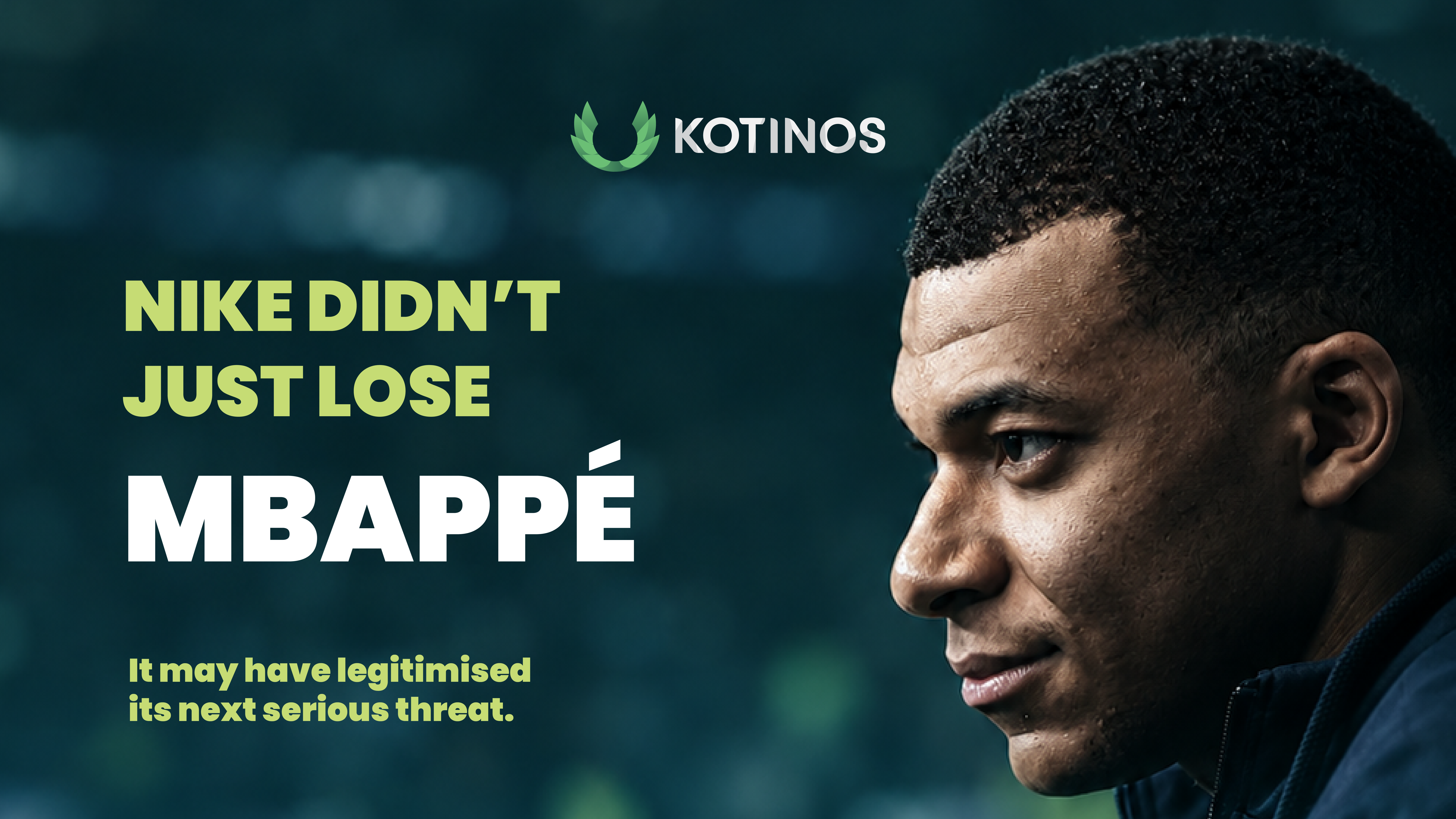
Mbappé is not the story, it's the market shift behind him that is.
Kylian Mbappé’s move from Nike to On has understandably dominated the sportswear conversation.
After almost two decades with Nike, one of football’s most commercially valuable athletes has joined a brand that has yet to release its first football boot. The immediate questions have focused on the partnership itself: Why did Mbappé leave? Why did On choose him? And what will the product look like?
But these are not the most important questions.
The real questions are, what does this move tell us about where the sportswear market and industry heading, and whether football’s established brand hierarchy is beginning to change.
For decades, football has largely been dominated by 3 key players: Nike, Adidas and Puma have defined the category through extensive athlete rosters, club and federation sponsorships, established product lines and decades of cultural relevance. Athletes occasionally moved between these brands, but the balance of power remained largely unchanged. One brand gained what another lost. However, On’s arrival is different. Mbappé has not moved from one established football brand to another. He has moved to a challenger entering the category with a different culture, operating model and innovation platform. That makes this more than an endorsement change. It may be an early signal of a wider market disruption.
The market was already changing.
Currently, On is not entering a stable market. Consumer preferences are fragmenting, newer performance brands are gaining visibility,and younger audiences are demonstrating less automatic loyalty to the brands that defined previous generations.
New Balance has steadily strengthened its position across performance and lifestyle. Other entrants have introduced new products and signed athletes, but their impact on football’s wider commercial structure has remained relatively contained.
Skechers entering football created interest. On entering alongside Mbappé, Thierry Henry and Sydney Schertenleib has the potential to create something more significant. The difference is not simply the profile ofthe athlete. It is the momentum and strategic infrastructure behind the brand. On ended 2025 with CHF 3.01 billion in net sales and expects constant-currency growth of more than 20% in 2026.
This is not a niche brand tentatively experimenting with football. It is one of the fastest-growing global sportswear businesses, using football as part of a much larger expansion strategy.
This implies that Nike’s challenge extends beyond losing one athlete. The brand remains the largest sportswear company in the world,and Mbappé’s departure will not change that overnight. But the timing matters.
Nike reported $46.4 billion in revenue for its 2026 fiscal year, flat on a reported basis and down 2% on a currency-neutral basis. The brand's revenue declined by 6%, including a 12% decline in Nike Brand Digital. The company itself acknowledged continuing top-line head winds and challenges inproduct sell-through. Its share of the global sports-footwear market also fell from 29.2% in 2022 to 22.9% in 2025, according to Euromonitor data reported by Reuters. During the 2026 World Cup, Adidas generated stronger early apparel spending and greater increases in store traffic, even though Nike remained highly visible on the pitch.
The issue is therefore not that Nike has suddenly become irrelevant. The issue is that its scale is no longer enough to guarantee cultural clout or consumer loyalty.
For older generations, Nike was often the default symbol of sporting aspiration. Younger consumers are encountering a more diverse landscape. Their consideration sets include On, New Balance, Hoka and several other brands that combine performance credibility with contemporary design, lifestyle relevance and a clearer sense of newness.
The next generation may admire Nike, but it will not necessarily inherit the same loyalty to it. That creates an opening: On does not need to beat Nike to threaten it. It only needs to take the most valuable bites. That could mean attracting a selective group of culturallyinfluential athletes, establishing authority in premium performance productsand capturing younger consumers before their brand preferences become fixed.Its early football strategy appears designed around exactly that logic.
Mbappé brings global influence and contemporary relevance.Thierry Henry, as Director of Football, adds experience and strategiccredibility. Sydney Schertenleib connects the brand with the next generationand gives women’s football a place within the product-development process from the outset. The combination is highly intentional: an established legend, a defining athlete of the present and a player representing the game’s future.
More importantly, On is positioning these figures as contributors to the business rather than faces placed in front of a finished product. They are expected to influence athlete recruitment, product testing,development and the brand’s broader relationship with football culture. This co-creation model could become one of On’s strongest competitive advantages.
Large names can offer history, scale and visibility. A challenger can offer athletes the opportunity to build something, shape the product and potentially participate more directly in the value they help create.
Innovation could change more than the boot
On’s strongest point of difference is not Mbappé alone. It is the innovation platform behind him. LightSpray™, the company’s robotic manufacturing technology, creates a seamless performance upper by spraying a continuous filament onto a shoe form. The process reduces a traditionally complex manufacturing sequence to a single automated step completed within minutes. On is now adapting the technology to football, with athletes contributing directly to the testing and refinement of future products.
If the technology performs at the elite level, its effect could extend beyond one football boot. LightSpray™ could become a visible signature for the brand in the way other proprietary technologies have helped competitors establish recognisable product identities. It may also create a halo effect across On’s wider portfolio by reinforcing the brand’s associations with lightness, precision, automation and modern design.
The longer-term opportunity is in apparel. On already operates across performance, lifestyle clothing, and accessories representing 7% of its 2025 sales, still a relatively small proportion of the business, but one that is expanding rapidly.
Its visual identity is also well suited to current tastes: clean, premium and easy to integrate into understated sportswear and lifestyle products. Football gives On a route into a much broader culture spanning performance, fashion, travel, training and everyday wear. If the football product succeeds, consumers may not stop at buying the boot. That is where the halo effect becomes strategically important. The boot establishes credibility; the athlete creates visibility; apparel expands the commercial opportunity.
The next three to five years will determine the outcome
The signing has created attention, but attention is not along-term strategy. To become a sustainable football brand, it will need to commit to the ecosystem surrounding the athlete. That means developing acredible product pipeline, recruiting the right mix of established and emerging players, supporting both the men’s and women’s game, building meaningful football communities and creating a consistent presence beyond major announcements.
Its roster will also need depth. A selective model can create distinction, but one athlete, even an athlete of Mbappé’s stature, cannot provide permanent relevance across markets, competitions and consumer segments. The next signings will reveal whether On is building a campaign or constructing a category.
Adapting the technology to this new football line matters.The brand's reputational risk is significant. When a brand makes a statement this large, it creates expectations among athletes, consumers and investors. If the product underperforms, the brand fails to support its talent or its involvement remains superficial, the same partnership that created credibility can expose the absence of a deeper strategy.
But if On commits, its influence could extend far beyond its own market share. Nike, Adidas and Puma may be forced to reconsider how they structure athlete relationships, accelerate innovation and communicate with younger consumers. Future partnerships may need to offer athletes more influence, deeper collaboration and a greater stake in the platforms they help build.
Our view: football’s brand hierarchy is becoming more open
On is unlikely to displace Nike or Adidas within the next three to five years. Their scale, distribution and institutional relationships remain difficult to replicate. But displacement is not the only measure of disruption.
A challenger can reshape a market by taking its fastest-growing consumers, attracting its most culturally relevant talent and forcing brands to change their behaviour. This is what makes On a credible threat.
The established brands are defending decades of dominance. On is offering athletes and consumers the possibility of creating what comes next. Mbappé’s move is therefore not the conclusion of the story. It is the first visible indication that football’s sportswear market may no longer belong exclusively to the brands that built & defined its past.
The question is no longer whether On can enter football. It is how much of the future it can take with it.